致命魔术
China's earliest tinned iron armor found in Zhejiang: 1,700-year-old anti-rust tech revealed_我的网站

A |
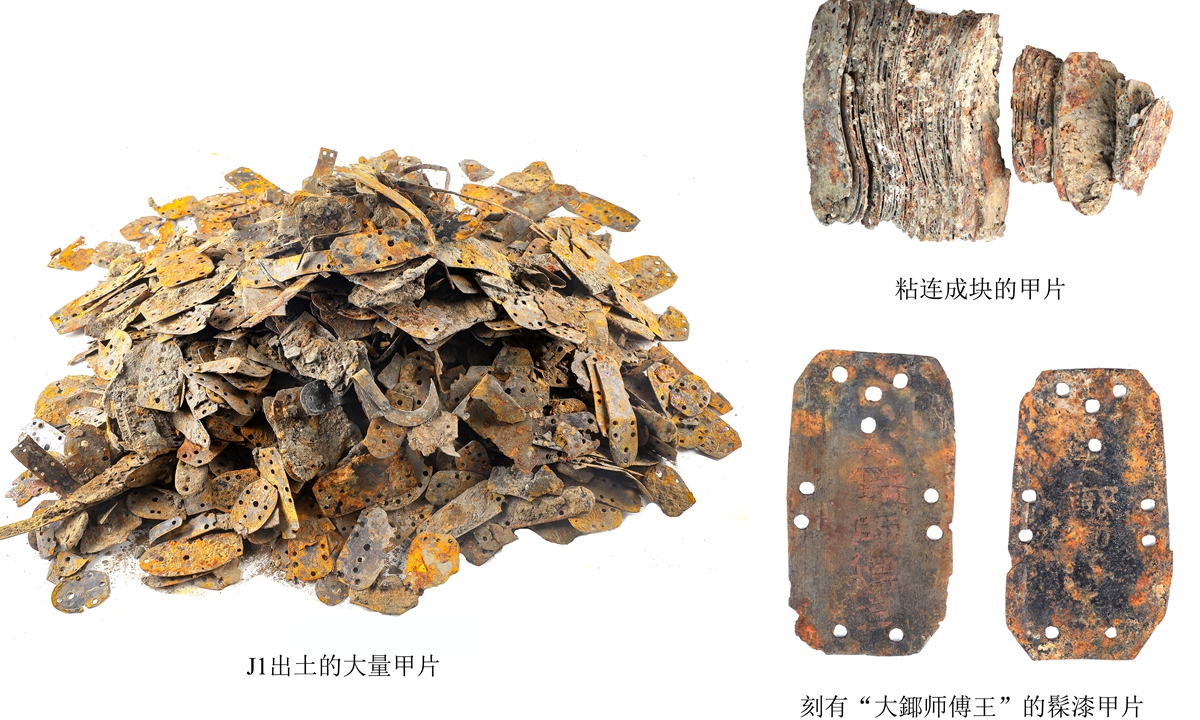
A number of tinned iron armor plates excavated from the Jizhong site Photo: Courtesy of the Shaoxing Institute of Cultural Relics and ArchaeologyArchaeologists at the Jizhong ruins site in Shaoxing, East China's Zhejiang Province, recently unearthed a large number of tinned iron armor plates and semi-finished pieces dating to the Wu period of the Three Kingdoms (222-280), according to the Shaoxing Institute of Cultural Relics and Archaeology. These discoveries represent the earliest known tinned iron artifacts in China to date, as well as the earliest tinned iron production remains found anywhere in the world, proving that an organized, systematic craft industry for tin-plated ironwork existed at that time.
While China has a long history of making tinned bronze and tinware, there has long been a lack of reliable historical records or physical evidence to prove early local production of tinned iron artifacts. The newly discovered armor plates can fill this gap, demonstrating that, by no later than the Wu period, local craftspeople in Zhejiang Province had mastered the art of tin-plating iron surfaces. This reflects the region's advanced metallurgical skills at that time, Ge Shuaikun, a researcher at the Shaoxing Institute of Cultural Relics and Archaeology, told the Global Times on Tuesday.
Over the last three years, archaeologists working at the Jizhong ruins site have excavated hundreds of tinned iron armor plates from ancient wells and ash pits. A preliminary investigation confirmed that the surfaces of these plates contain high levels of tin. Subsequent laboratory analyses were conducted in collaboration with the Shaoxing's institute and the Institute for Cultural Heritage and History of Science & Technology at the University of Science and Technology Beijing with methods such as Scanning Electron Microscopy with Energy Dispersive Spectroscopy (SEM-EDS), X-ray Diffraction (XRD), and Micro-CT to deeply examine the samples' materials, structures, and technological traces.
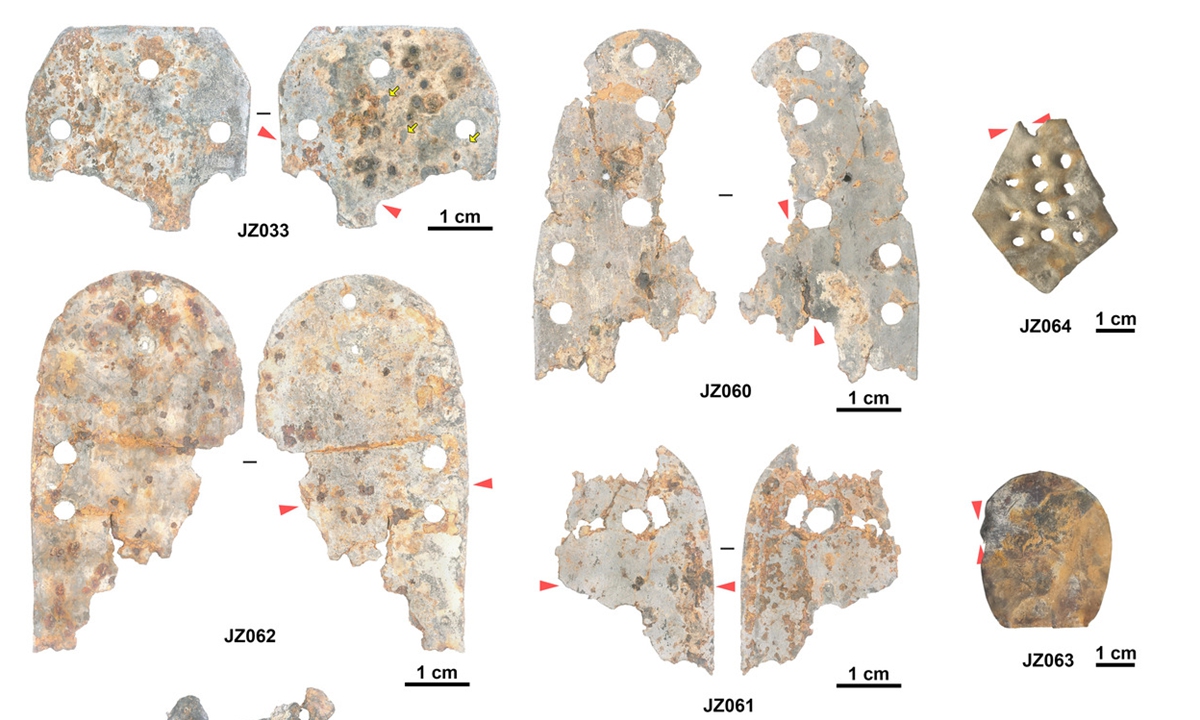
Photo: Courtesy of the Shaoxing Institute of Cultural Relics and ArchaeologyAccording to Ge, tin is a non-toxic metal with a low melting point, excellent corrosion resistance, and a silvery sheen. Tin plating effectively prevents rust, making iron armor far more durable and indeed, even after being buried for 1,700 years, many of these tinned plates retain their silvery metallic shine.
Research shows that the craftspeople immersed iron armor plates in molten tin, thus ensuring complete coverage of the surface with a continuous tinned layer. This coating isolated the iron from exposure to air and moisture, dramatically boosting corrosion resistance. Many of the excavated tinned armor pieces still show a clear, bright silver-white finish.
One major reason for tin-plating the armor was to prevent rust. At the same time, the silvery white shine of tinned iron offered a more striking, beautiful appearance, standing out from the typical dark iron armor of the era. This visual distinction may have marked these pieces as a higher-grade military asset, according to an article from the University of Science and Technology Beijing's official website.
The article said that in earlier eras, from the pre-Qin to Han dynasties, tin was widely used as a surface coating on bronzeware and ceramics. Researchers believe the tin-plating of iron armor discovered at the Jizhong ruins site during the Wu period of Three Kingdoms built upon this local tin-coating tradition, representing an adaptation of those techniques across different materials. The process likely benefited from technological exchange among various specialized workshops at the site, including those making bronze castings, iron weapons, and other metallurgical products.
。 国庆假期,朝阳市牛河梁遗址博物馆吸引了不少初中生前来研学“打卡”。有人远道而来,第一次感受红山文化的魅力,也有人“二刷”“三刷”博物馆,不时在感兴趣的文物前驻足。牛河梁遗址博物馆受到初中生青睐的原因之一,是本学期启用的新修订的义务教育历史教材中,正式纳入牛河梁红山文化遗址相关内容,许多学生“按图索骥”,来到教材“取景地”一探究竟。
今年秋季学期起,根据2022年版义务教育课程标准修订的教材陆续投入使用。新版教材《中国历史》七年级上册中,牛河梁遗址相关内容出现在第一单元“中华文明的起源”中,红山文化以其独特的魅力和深远的历史价值,成为广大师生探索中华文明悠久历史与灿烂文化的重要篇章。
“牛河梁遗址位于辽宁朝阳,属于西辽河流域的红山文化,距今约5800年—5000年。”看到家乡辽宁的历史遗址出现在课本上,沈阳市第七中学的学生感到格外自豪。“讲到这里时,孩子们都抢着发言。”七中历史教师赵淼在课上会展示玉猪龙等文物的图片,每到这时,学生的热情都高涨起来。为了进一步引导学生传承和弘扬中华优秀传统文化、深入了解家乡历史,赵淼在课上布置了特色实践作业,要求学生自选教材中涉及的文物为大家讲解,牛河梁遗址的文物成为最受学生关注的内容。
在牛河梁遗址的“老家”,几个月前,朝阳市教师进修学院初中历史教研员李岩就和同事开始了实地考察、专题研讨、课程设计等与牛河梁遗址相关的教研活动,希望配合新版教材的使用,开发更多具有地方特色的课程和教学资源。

B | “自豪的同时,更要深入挖掘家乡的历史文化资源,进一步培养孩子们的文化自信。”李岩说。
责任编辑:刘春阳。
Current article:http://uui2ep0.dinggaxilianmaiyuejienianguai.shop/k1yy/0ri.html
Published on:16:42:33